How to Handle a Balloon Payment Coming Due: Your Complete Guide to Commercial Loan Refinance Options

Terrydale Capital
Jan 16, 2026 21 Min read

You took out a commercial loan five or seven years ago. The payments have been manageable. The property has performed well. But now something looms on the horizon that keeps you up at night.
Your balloon payment is coming due.
That large lump sum at the end of your loan term can feel overwhelming. For many commercial real estate owners, it represents hundreds of thousands or even millions of dollars due all at once. The good news? You have options. The key is understanding them early and acting before time runs out.
What Exactly Is a Balloon Payment?
A balloon payment is the final payment on a commercial loan that pays off the remaining balance in one lump sum. Unlike residential mortgages that spread payments evenly over 30 years, most commercial loans work differently.
Here is a simple example. You borrow $2.5 million at a 9% interest rate with a 10-year term. Your payments are calculated based on a 25-year amortization schedule, which keeps monthly payments lower. But when those 10 years end, you do not keep paying for another 15 years. Instead, you owe whatever balance remains.
In this case, that remaining balance would be around $2.2 million. Due all at once.
This structure exists because commercial lenders want flexibility. They do not want to lock in rates for 25 or 30 years. The shorter term protects them from interest rate changes and gives them regular opportunities to reassess the loan.
For borrowers, balloon payments create a deadline. You must either pay off the remaining balance, sell the property, or refinance into a new loan. Most owners choose refinancing.
Why Balloon Payments Create Challenges in 2025
The commercial real estate market has shifted dramatically since many current balloon loans originated. Back in 2019 or 2020, interest rates sat near historic lows. Lenders offered generous terms. Property values climbed steadily.
Today the landscape looks different. Interest rates remain elevated compared to those earlier years. Property values have stabilized or declined in some sectors. Lenders have become more selective about which loans they approve.
This creates what industry experts call the maturity wall. According to recent data, approximately $936 billion in commercial real estate loans are scheduled to mature in 2026 alone, representing a 19% increase over 2025. Many of these originated when rates were lower and values were higher.
The disconnect between original loan terms and current market conditions has made refinancing more challenging for some borrowers. Properties that easily qualified for financing five years ago may struggle to meet today's stricter underwriting standards.
But challenges are not impossibilities. Understanding your options helps you navigate this environment successfully.
Six Refinance Options for Your Balloon Payment
When your balloon payment approaches, you have several paths forward. Each comes with distinct advantages depending on your property type, financial situation, and investment goals.
1. Agency Loans: Fannie Mae and Freddie Mac
For multifamily properties, agency loans remain the gold standard for refinancing. Fannie Mae and Freddie Mac offer some of the most competitive terms available for apartment buildings with five or more units.
The numbers tell the story. Fannie Mae fixed-rate loans offer terms between 5 and 30 years with amortizations up to 30 years. You can typically borrow up to 80% of the property value for standard refinances or 75% for cash-out refinances. Rates generally fall between 5.5% and 7% depending on market conditions, property quality, and loan structure.
Freddie Mac offers similar programs with one notable advantage: you can lock your interest rate at application rather than waiting until loan approval. In a volatile rate environment, this protection proves valuable.
Both agencies require stabilized properties with at least 90% occupancy for 90 days before funding. Borrowers typically need prior multifamily experience, though waivers are sometimes available. The loans are non-recourse, meaning your personal assets remain protected if the property defaults.
For a $5 million apartment refinance, an agency loan might look like this: 10-year term, 30-year amortization, 6.5% fixed rate, 75% LTV. Monthly payments of approximately $27,500 with predictable long-term costs.
2. CMBS Loans
Commercial mortgage-backed securities loans work well for larger properties and borrowers who value non-recourse terms. CMBS lenders pool multiple loans together and sell them to investors as securities, which creates unique characteristics.
CMBS loans typically offer 5 to 10-year terms with competitive rates. They work across most commercial property types including retail, office, industrial, and hospitality. Leverage can reach 75% or higher for strong properties.
The trade-off involves less flexibility. Once your loan is securitized, modifying terms becomes difficult. Prepayment often requires defeasance, a process that can cost tens of thousands of dollars.
Recent industry data shows CMBS issuance has remained robust, with private-label CMBS reaching $92.48 billion through the first three quarters of 2025. Strong demand from bond investors keeps this capital source active even as some lenders have pulled back.
3. Bridge Loans
Sometimes your property needs improvement before it qualifies for permanent financing. Perhaps occupancy has slipped. Maybe the building needs renovations to command market rents. A bridge loan provides temporary funding while you stabilize the asset.
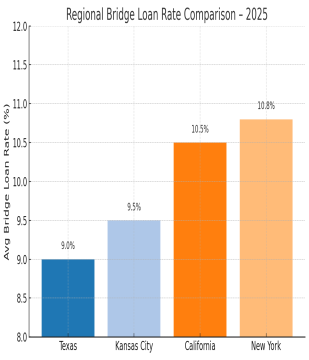
Bridge loans typically run 12 to 36 months with interest-only payments. Rates run higher than permanent financing, often in the 9% to 15% range depending on property condition and borrower strength. But they offer speed and flexibility that traditional lenders cannot match.
Consider this scenario. Your balloon payment comes due in 90 days. Occupancy sits at 78%, below the 90% threshold most permanent lenders require. A bridge loan pays off your existing balance, giving you 24 months to execute your lease-up strategy. Once occupancy stabilizes, you refinance into long-term financing at better terms.
The key with bridge financing is having a clear exit strategy. Know exactly how you will transition to permanent debt before taking the loan.
4. Life Insurance Company Loans
Life insurance companies represent some of the most stable and competitive lenders in commercial real estate. They manage portfolios funded by insurance premium reserves, which creates long investment horizons and conservative underwriting.
Life company loans offer several advantages. Interest rates typically rank among the lowest in the market. Terms extend from 5 to 30 years, sometimes with full amortization that eliminates future balloon payments entirely. Many loans are non-recourse with assumable terms that benefit future sales.
The requirements tend to be strict. Life companies prefer Class A properties in major markets. They typically lend between 60% and 75% of value with debt service coverage ratios of 1.25x or higher. Borrowers need strong financials and commercial real estate experience.
For the right property and borrower, life company financing provides exceptional long-term stability. One notable advantage: many life companies allow rate locks at application, protecting you from market volatility during the closing process.
5. Bank Loans
Traditional bank financing remains a viable option, especially for borrowers with existing banking relationships. Banks can offer more flexibility in structuring terms and may consider factors that other lenders overlook.
Bank loans typically offer competitive rates with 5 to 10-year terms. Some banks provide interest-only periods or adjustable rates that might suit your investment strategy. The relationship aspect can prove valuable when you need modifications or have questions during the loan term.
The downside is that most bank loans require full recourse, meaning you personally guarantee the debt. Banks have also become more conservative in their commercial real estate lending since 2023, with tighter underwriting standards and lower leverage limits.
6. SBA 504 Loans
For owner-occupied commercial properties, SBA 504 loans offer a compelling option. These government-backed loans provide below-market fixed rates with terms up to 25 years and amortization that matches the term.
You can refinance up to 90% of your property's appraised value through the SBA 504 program. If eligible business expenses are included, the maximum drops to 85%. Some borrowers can even cash out up to 20% of the building value for business expenses like operating costs, employee wages, or inventory.
The fixed rates and long amortizations eliminate future balloon payment concerns entirely. For small business owners facing balloon maturities on their commercial real estate, the SBA 504 refinance option deserves serious consideration.
How to Prepare for Your Balloon Payment Refinance
Successful refinancing does not happen at the last minute. The borrowers who achieve the best outcomes start planning early and execute methodically.
Start 12 to 18 Months Before Maturity
Begin exploring your options at least a year before your balloon payment comes due. This timeline provides enough cushion to address any issues that arise during underwriting. It also gives you leverage to negotiate with multiple lenders rather than accepting whatever terms you can get under time pressure.
Use this early period to gather documentation. Pull your property financials, rent rolls, and operating statements. Review your personal financial situation including credit scores, liquidity, and net worth. Understand exactly where you stand before approaching lenders.
Know Your Property's Current Value
Property values have shifted significantly in recent years. What your building was worth when you originated your loan may differ substantially from its value today. Getting an early sense of current market value helps you understand how much you can realistically borrow.
If your property has declined in value, you may face a gap between your loan balance and what lenders will finance. Identifying this early gives you time to prepare additional equity or negotiate with your existing lender for an extension.
Evaluate Your Debt Service Coverage
Lenders evaluate your property's ability to cover debt payments through the debt service coverage ratio. This calculation divides your net operating income by your annual debt payments. Most lenders require a DSCR of at least 1.20x to 1.35x.
Calculate your current DSCR using realistic projections of the new loan terms. If it falls short, identify ways to improve property income or reduce operating expenses before refinancing.
Consider All Your Options
Do not limit yourself to the same type of financing you have today. Your situation may have changed in ways that open new possibilities. A property that did not qualify for agency financing five years ago might qualify today. A life company loan that seemed out of reach might now be attainable.
Working with a commercial mortgage advisory firm gives you access to the full spectrum of lending options. Different lenders have different appetites at different times. An experienced advisor knows which lenders are actively lending on your property type in your market.
What If You Cannot Refinance?
Sometimes the numbers simply do not work. Property values have dropped too far. Income has declined too much. Lender requirements have tightened too severely. If refinancing proves impossible, you still have options.
Request a Loan Extension
Many lenders prefer extending loans over taking back properties. If you have maintained good standing on your payments and can demonstrate a viable path forward, your current lender may grant a 6 to 18-month extension. This buys time for market conditions to improve or for you to implement operational improvements.
Recent industry data shows that approximately 9.7% of CMBS loans by balance received extensions in 2025 rather than paying off at maturity. Extensions have become an accepted resolution strategy for loans with limited near-term refinancing viability.
Bring In Additional Equity
If your refinance falls short because of declining property values, additional equity can bridge the gap. This might come from your own capital, a new equity partner, or preferred equity financing. The cost of additional equity usually beats the alternative of losing the property.
Sell the Property
Sometimes the best decision is to exit the investment. If your property cannot support refinancing and you cannot or will not invest additional equity, a sale allows you to recover your remaining equity and move on. In a market with active buyers, this may be the cleanest solution.
The Bottom Line on Balloon Payment Refinancing
A balloon payment does not have to become a crisis. With proper planning, realistic assessment, and expert guidance, most borrowers successfully navigate their loan maturities and position their properties for continued success.
The keys are starting early, understanding all your options, and working with advisors who know the lending landscape. Every property and borrower situation differs. What works for one investor may not work for another.
What matters is taking action before time runs out. The borrowers who struggle are those who wait until their balloon payment is 60 or 90 days away before seeking solutions. By then, options have narrowed and leverage has disappeared.
If your commercial loan maturity approaches within the next 18 months, now is the time to start planning your refinance strategy.
Get Help with Your Commercial Loan Refinance
Navigating balloon payment refinancing requires expertise across multiple lending channels and deep relationships with capital sources. At Terrydale Capital, we specialize in connecting commercial real estate owners with the right financing solutions for their unique situations.
Whether you need agency financing for your multifamily property, a bridge loan to stabilize an asset, or guidance on which refinance option fits your investment strategy, our team is ready to help.
Contact Terrydale Capital to discuss your balloon payment refinance options today.
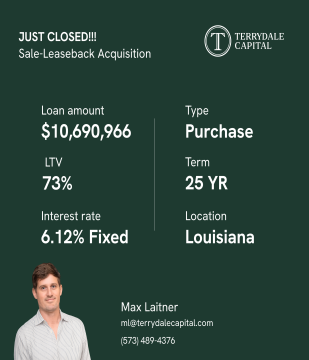
Learn more about our commercial loan services and explore our recent closed deals to see how we have helped investors like you navigate complex financing situations.
Partner With Terrydale Capital for Your Debt Financing Needs
When it comes to debt financing, understanding the right timing, process, and options is crucial. At Terrydale Capital, we provide a comprehensive range of commercial loan solutions tailored to meet your business's unique needs.












































































Success!
Product has been created successfully!
Headquartered in Dallas, Texas, Terrydale Capital is a leader in commercial real estate financing. We have close relationships with the nation’s top banks, lenders & family offices allowing us to provide the most competitive financing solutions in the market.


