Is It a Good Time to Refinance a Commercial Real Estate Loan?

Terrydale Capital
Jan 23, 2026 19 Min read

Nearly $1 trillion in commercial real estate loans matured in 2025. Another wave is coming in 2026. If you own commercial property, you may be asking yourself: should I refinance now, or wait?
The answer depends on your situation. Your current rate. Your loan balance. Your property's value. Your goals.
This guide breaks down the three main types of refinancing, when each makes sense, and how to think through the decision in today's market.
What Does It Mean to Refinance a Commercial Real Estate Loan?
Refinancing simply means replacing your current loan with a new one. The new loan pays off the old one, and you start fresh with different terms.
There are three main reasons property owners refinance:
Rate and term refinancing lets you change your interest rate, loan length, or both. Your loan amount stays roughly the same. The goal is usually to lower your monthly payment or lock in better terms.
Cash-out refinancing means borrowing more than you currently owe. You take the difference in cash. Property owners use this money to buy more real estate, make improvements, or fund other business needs.
Balloon payment refinancing happens when your loan is coming due. Many commercial loans have balloon payments, which are large lump sums owed at the end of the loan term. Refinancing lets you avoid paying that balloon and extend your financing.
Each type serves a different purpose. Let us look at when each makes sense.
Rate and Term Refinancing: When Lower Rates Are the Goal
The simplest reason to refinance is to get a better rate. If rates have dropped since you took out your loan, you might be able to reduce your monthly payment.
Say you have a $5 million loan at 7% interest on a 25-year amortization. Your monthly payment is about $35,330. If you could refinance to 6%, your payment drops to roughly $32,220. That is $3,110 per month. Over ten years, you would save more than $370,000 in interest.
But rates have not dropped much lately. According to Freddie Mac, long term multifamily interest rates have stayed relatively flat. On January 2, 2025, the 10-year fixed rate averaged from 6.13% to 6.91%. By late 2025, rates averaged around 6.79% to 6.95%.
So if you locked in a loan at 3.5% five years ago, refinancing today would actually raise your rate. That is the challenge many owners face right now.
Many borrowers now face refinancing rates double or even triple what they secured years ago, with a 3.5% loan from 2016 potentially refinancing at 7%.
When does rate and term refinancing still make sense?
Your current rate is higher than today's market. If you took out a bridge loan at 9% or a hard money loan at 12%, refinancing into a conventional product would save you money.
You want to switch from floating to fixed. Refinancing also lets you lock in lower long-term interest rates, which offers stability in financial planning.
Your creditworthiness has improved. If your financials are stronger than when you first borrowed, lenders may offer better terms.
Cash-Out Refinancing: Unlocking Equity Without Selling
Cash-out refinancing works differently. Instead of keeping your loan amount the same, you borrow more and pocket the difference.
You bought a retail center for $3 million five years ago with a $2.25 million loan. The property is now worth $4 million, and your loan balance has dropped to $2 million. With a cash-out refinance at 70% loan-to-value, you could borrow up to $2.8 million. After paying off your $2 million balance, you would receive $800,000 in cash.
With a cash-out refinance, owners can reach into the equity of their property and repurpose it, reinvesting in new assets, improvements, or business expansion without selling.
The benefits are clear. You access capital without triggering a sale. You keep the property. You continue collecting rent. And unlike dividends or capital gains, the borrowed money is not taxable income.
But there are risks.
Commercial real estate markets can experience fluctuations, and property values may decline during economic downturns. If an investor performs a cash-out refinance at the peak of a market cycle and property values subsequently decline, they may end up owing more on their property than its current market value.
You also increase your debt load. Higher debt means higher monthly payments. If rents drop or vacancies rise, you could face cash flow problems.
Lenders typically require that investors maintain a minimum equity stake in the property post-refinance, often around 20-25%. Consequently, investors usually need at least 30-40% equity before considering a cash-out refinance to meet these requirements.
Balloon Payment Refinancing: Managing the Maturity Wall
Most commercial loans do not fully pay off over their term. Instead, they have balloon payments.
You take out a loan with a 10-year term but a 30-year amortization. Your monthly payments are calculated as if you had 30 years to pay, which keeps them low. But the entire remaining balance comes due at the end of year ten.
Let's say that you take out a loan for $5 million to purchase a retail property. The loan has a term of 10 years, the interest rate is 5%, and it amortizes over 30 years. The monthly payments would be approximately $27,000. Because the loan isn't fully amortizing, there will be a significant chunk left to pay at maturity, close to $4.1 million.
That $4.1 million is your balloon payment. Most owners do not have that kind of cash sitting around. So they refinance.
This is where the current market gets tricky.
The $957 billion in commercial real estate loans maturing in 2025 represents nearly triple the 20-year average, creating unprecedented refinancing pressure.
When combined with the volume of loans expected to mature in 2026, the industry is facing well over $1.5 trillion in refinancing activity within a two-year window.
The average interest rate on these maturing loans is estimated at 4.91% for 2025 maturities, significantly lower than current refinancing options above 6.0%.
What does this mean for you?
If you refinance today, your new rate will likely be higher than your old one. Your monthly payment will increase. And depending on how much your property's value has changed, you may not be able to borrow enough to pay off the existing loan.
Many borrowers who are looking to refinance loans taken out five to ten years ago are experiencing several obstacles. First, since rates are higher, many loans are coming up cash-short (the new loan amount is not enough to pay off the maturing loan). These borrowers are often required to inject more cash into their deals or take on equity partners who are willing to invest.
A loan that once could refinance 75% of a property's value may now be limited to just 55-60%, creating a capital gap that the owner must plug with cash or alternate financing.
If you have a balloon payment approaching, start planning now. The single biggest mistake owners make is waiting too long. By starting discussions with lenders and advisors 18-24 months before maturity, you gain time to explore refinancing, equity partners, or even partial dispositions.
Understanding Today's Commercial Refinancing Landscape
Tighter lending standards and higher interest rates have made it harder for business owners to secure or refinance commercial real estate loans.
From December 2024 through August 2025, the Fed held rates steady amid ongoing uncertainty around tariffs and inflation. In September and October 2025, the Fed implemented another two 25-bps cuts. If the pattern holds, further rate cuts in late 2025 may not result in significant decreases in the 5-Year Treasury yield.
The Mortgage Bankers Association is projecting 6.2% by year end 2025. The National Association of Realtors predicts mortgage rates will end 2025 at 6.01%.
Here is what that means for different refinancing strategies:
Rate and term refinancing is challenging unless your current rate is very high. Cash-out refinancing remains possible if your property has appreciated and generates strong cash flow. Balloon refinancing is happening regardless of rate environment.
Commercial Loan Options for Refinancing
Different lenders offer different products.
Agency Loans (Fannie Mae and Freddie Mac) work well for multifamily properties. Fannie Mae offers non-recourse apartment financing in amounts between $1 million and $100 million, with fixed interest rates and LTVs up to 80%.
Bank and Credit Union Loans offer flexibility for mid-sized loans. In today's current market, bank and credit union loans may offer more attractive terms on $1-10 million loans versus debt funds, CMBS, and agency debt.
CMBS Loans work for larger properties with stable cash flow. These loans are non-recourse and focus on property performance rather than borrower credit.
Life Company Loans offer excellent terms for Class A properties. These lenders typically offer 25-year, fully-amortizing loans with competitive rates and LTVs between 50 and 70%.
SBA 504 Loans help owner-occupied properties with financing up to 90% of the appraised property value and below-market fixed rates.
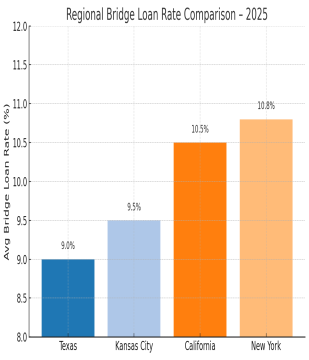
Bridge Loans work for transitional properties. Rates are higher, typically 7% to 14%, but qualification is easier.
Key Metrics Lenders Evaluate
Two metrics matter most when refinancing commercial real estate.
Loan-to-Value Ratio (LTV) measures how much you are borrowing compared to your property's value. We often see maximum loan-to-value ratios in the 65%-70% range today as a result of higher rates.
Debt Service Coverage Ratio (DSCR) measures whether your property's income can cover the loan payment. Most lenders want a DSCR of at least 1.25.
Today's higher rates are causing mortgage payments which are often rising faster than the rental income increases will bear. Until rates ease, many borrowers will have difficulty refinancing their existing loans.
Should You Refinance Now or Wait?
Refinance now if:
- Your balloon payment is coming due within 18 to 24 months
- Your current rate is significantly higher than today's market
- You need to switch from floating to fixed rate
- Your property has appreciated and you want to access equity
Consider waiting if:
- Your current rate is below 5% with years left on your term
- Your property value has declined
- You expect rates to drop significantly and can afford to wait
Act with caution if:
- Your property is struggling with vacancies
- The new payment would strain your cash flow
- You would need to inject significant capital
Office vacancy rates close to 20% at the national level highlight the sector's structural crisis. If you own office property, refinancing is more complex.
The Cost of Refinancing
Refinancing is not free. Borrowers should anticipate lender fees ranging from 1-3% of the new loan amount and closing costs between 2-5%.
For a $5 million loan, that could mean $150,000 to $400,000 in costs. Add appraisal fees, legal fees, title insurance, and prepayment penalties on your existing loan.
Generally, if loans carry prepayment penalties, the prepayment penalty is waived in the last 90 days before maturity so the borrower can refinance or sell without being penalized.
Get Expert Guidance on Your Commercial Refinance
Navigating today's commercial real estate lending market takes expertise. There are many reasons to work with a qualified and experienced commercial mortgage broker. A mortgage broker will have a large database of capital sources, including agency lenders, insurance companies, CMBS lenders, national, regional and local banks, credit unions, debt funds, and private lenders to choose from.
Unlike many consumer or small-business loans, commercial real estate loans often leave room for negotiation, especially for well-qualified borrowers. If you've received a better offer from another lender, use it as leverage to negotiate a lower rate, reduced fees or more favorable terms.
At Terrydale Capital, we specialize in helping property owners find the right commercial real estate refinancing solution. Whether you need to address a balloon payment, lower your rate, or access equity through a cash-out refinance, our team has the relationships and experience to get it done.
Ready to explore your refinancing options? Contact Terrydale Capital today to speak with one of our commercial mortgage experts.
Partner With Terrydale Capital for Your Debt Financing Needs
When it comes to debt financing, understanding the right timing, process, and options is crucial. At Terrydale Capital, we provide a comprehensive range of commercial loan solutions tailored to meet your business's unique needs.
































































Success!
Product has been created successfully!
Headquartered in Dallas, Texas, Terrydale Capital is a leader in commercial real estate financing. We have close relationships with the nation’s top banks, lenders & family offices allowing us to provide the most competitive financing solutions in the market.


