Hard Money Loans for Commercial Real Estate in Texas: What They Are and What They Cost.

Terrydale Capital
Aug 10, 2026 26 Min read

Most commercial real estate borrowers spend the bulk of their time thinking about conventional financing. Bank loans, agency debt, SBA programs. That is the right instinct most of the time. But there is a category of deals where conventional financing simply cannot execute, either because the property is in no shape to qualify, the timeline is measured in days rather than months, or the borrower's situation does not fit inside a bank's underwriting criteria. That is the space hard money occupies, and for the right deal, nothing else comes close.
Hard money loans get a mixed reputation in CRE circles. Some borrowers treat them like a last resort, a sign something went wrong. Others, particularly experienced investors who have used them repeatedly and profitably, see them as a legitimate piece of the financing toolkit. The truth sits somewhere practical: hard money is expensive, fast, and flexible, and whether those characteristics work for or against you depends entirely on how clear-eyed you are about what you are getting into.
What Hard Money Actually Is
A hard money loan is a short-term loan from a private lender, not a bank, underwritten primarily against the value of the property rather than the financial profile of the borrower.
That single difference in underwriting focus changes almost everything about how these loans work. When a bank approves a commercial loan, most of the analysis is about the borrower. Income, credit history, net worth, business track record, tax returns going back years. When a hard money lender looks at a deal, most of the analysis is about the property. What is it worth right now? What will it be worth after improvements? If something goes sideways, how quickly can the lender recover their capital?
This is what makes hard money accessible to borrowers who cannot satisfy conventional requirements. Real estate investors operating through LLCs with limited operating history. Self-employed owners whose tax returns show a complex income picture that a bank cannot easily underwrite. Buyers acquiring properties in a physical condition that a conventional appraisal would flag. None of these scenarios automatically disqualify a borrower from hard money consideration, because the lender is primarily asking a different question.
What Hard Money Costs in Texas Right Now
According to data from Lightning Docs, the average interest rate for Texas hard money loans in the second quarter of 2026 was 10.14%, across 1,130 short-term loans funded between April 1 and June 30, 2026. In the first quarter of 2026, the average rate was 9.38% with average origination fees of 3.0 points and an average LTV of 71%.
For commercial specifically, rates run higher than residential fix-and-flip programs. Commercial hard money rates in Texas as of mid-2026 generally fall between 9% and 14% depending on property type, borrower experience, leverage, and deal complexity. Multifamily and industrial at lower leverage land at the lower end. Higher-risk value-add or construction deals price toward the top.
Beyond the interest rate, several other costs add up fast and are worth understanding before you commit to a loan:
Origination fees run between 1.5 and 3 points for most commercial deals, where each point equals 1% of the loan amount. On a $2 million loan at 2 points, that is $40,000 at closing before a dollar of interest accrues.
Extension fees apply if your project runs past the original loan term. Most lenders charge between 0.5% and 1% of the outstanding balance per extension period. This is a real cost you should budget for as a contingency, not ignore and hope you do not need.
Interest reserves are required by some lenders at closing, typically covering two to three months of interest payments, drawn from your equity contribution rather than loan proceeds. On a $1.5 million loan at 10.5% interest-only, monthly interest is roughly $13,125. A three-month reserve means over $39,000 set aside at closing.
Third-party costs including appraisals, property condition assessments, and environmental reports are your responsibility regardless of whether the loan closes.
When you add rate, points, extensions, reserves, and fees together honestly, the total carrying cost of a hard money loan in Texas today typically runs between 12% and 18% annualized. Any deal analysis built only on the stated rate is incomplete.
Loan-to-Value in Commercial Hard Money
LTV for commercial hard money loans in Texas generally falls between 60% and 75%, with the average running around 71% based on first-half 2026 data. Most lenders cap standard deals at 65% to 70% as-is value, with stronger borrowers on lower-risk deals accessing up to 75%.
For value-add or construction projects, lenders often shift from as-is LTV to loan-to-cost underwriting, covering 65% to 75% of total project cost including acquisition, renovation, and carrying expenses. The equity cushion between the loan balance and property value is the lender's primary protection, which is why leverage compression happens quickly when property type or sponsor risk increases.
Some Texas private lenders will work with borrowers who have credit scores as low as 580, though rates run higher in the 10% to 15% range and LTVs are lower at 60% to 70% for those profiles. First-time borrowers on complex deals generally sit at 60% to 65% LTV. Experienced sponsors with a clean track record and a well-structured exit can often access 70% to 75%.
Knowing where your deal falls on this spectrum before you start lender conversations determines which ones are worth having.
When Hard Money Actually Makes Sense
Hard money is not a replacement for conventional financing. It works in specific situations where conventional financing cannot. Here are the ones that come up most often for Texas commercial borrowers:
The property does not qualify for conventional financing yet. Banks and agency lenders require stabilized occupancy, clean appraisals, and a property in acceptable physical condition. A building sitting at 40% occupied, carrying deferred maintenance, or flagged for environmental issues will not pass conventional underwriting. Hard money carries the deal while the borrower executes the business plan, stabilizes the property, and positions it to refinance into permanent debt. It bridges the gap between what the property is today and what conventional lenders need it to be.
The timeline is too short for a bank. Conventional commercial loans take 60 to 90 days under normal conditions, longer when underwriting gets complicated. Texas hard money and bridge lenders can close in five to fifteen business days in many cases, which matters enormously when you are competing on a contract with a tight closing window, buying at a foreclosure or estate sale, or rescuing a deal where another buyer's financing collapsed at the last minute. Speed is the primary reason most commercial borrowers pay the hard money premium.
The borrower does not fit the conventional underwriting box. Complex LLC structures, self-employment income that does not present cleanly on a tax return, a credit event in the past few years, or simply a lack of two years of documented business history can all block a conventional approval regardless of how good the deal is. Hard money lenders look at the asset and the exit strategy. If both are sound, borrower complexity matters far less.
The opportunity cost of missing the deal exceeds the cost of the loan. If a motivated seller is offering a $5 million property at $3.2 million and requires a 15-day close, the cost of a 12-month hard money loan at 11% is roughly $352,000 in interest. If the deal creates $1.5 million in value after repositioning, paying $352,000 plus points to capture that spread is a straightforward calculation. The hard money cost is not the question. The question is whether the deal justifies it.
When Hard Money Is the Wrong Move
It is equally important to know when not to use it.
If a conventional loan will work, use it. The spread between a conventional bank rate at 6.5% and a hard money rate at 11% on a $2 million loan is $90,000 per year. There is no deal where paying that premium makes sense if conventional financing is available and the timeline is workable.
If you need long-term financing, hard money is structurally wrong for the job. These loans run 12 to 24 months with balloon payments at maturity. Using hard money as a long-term hold strategy means you face a forced refinance or sale at maturity regardless of market conditions, and each extension or refinance costs money and introduces risk. Borrowers who use hard money because they cannot qualify conventionally are solving this month's problem by creating next year's crisis.
If the exit is unclear or built on optimistic assumptions, hard money is particularly dangerous. These loans expire on a fixed date, and the lender fully expects to be paid off. If your exit depends on values rising significantly, a lease-up taking less time than is realistic, or a permanent financing market that may be tighter when you need it, you are making a bet rather than executing a plan. Hard money loans that hit maturity without a clean exit path lead to expensive extensions, forced discounted payoffs, or in the worst cases, lender-initiated foreclosure.
The Exit Strategy Has to Come First
Every hard money loan has an expiration date. Most of the problems that borrowers run into with these loans trace back to one root cause: they did not underwrite the exit before signing the note.
The two most common exits are refinancing into conventional or permanent debt once the property stabilizes, or selling the improved property. Either works. What does not work is starting a hard money loan without knowing which of these you are executing and what it requires.
For a refinance exit, you need to know in advance what the stabilized property will support on a conventional loan basis. What NOI does it need to produce? What occupancy does it need to sustain? What DSCR does your target lender require, and what rate are they using to calculate it? Work backward from those requirements to determine whether your business plan actually produces a refinanceable asset within the time your hard money term allows. Terrydale's refinance calculator is a straightforward tool for running that math before you commit.
For a sale exit, you need realistic confidence in the as-improved value and the speed of the market you are selling into. Soft markets move slowly. If your 12-month hard money loan expires during a quarter when buyers are cautious and transaction volume is light, a forced timeline can compress your margin significantly.
Hard Money vs. Bridge Loans
These two terms get used as synonyms in casual conversation. They are not the same product.
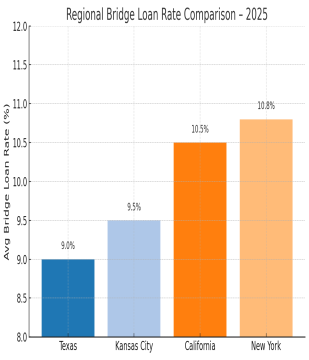
Institutional bridge loans come from debt funds, specialty finance companies, and some banks. They target similar situations as hard money but underwrite more like conventional lenders. Sponsor credit, track record, and deal quality all matter. The tradeoff is better pricing, typically 8% to 11% for commercial deals in Texas today, at the cost of more documentation and longer closing timelines than true hard money.
Hard money is more purely asset-based. Less documentation, faster close, higher rate, and more flexibility on borrower credit. Both products serve transitional deals, but they draw from different capital sources and carry different requirements. Knowing which one fits your deal before you start calling lenders saves time on both sides of the conversation.
For a fuller breakdown of how bridge financing works and when it makes more sense than a hard money approach, Terrydale's article on bridge loans versus permanent financing covers that comparison in detail. And for deals that sit in the gray zone between hard money and institutional bridge, Terrydale's bridge financing program covers both ends of the transitional lending spectrum.
What You Need to Bring to a Hard Money Lender
Because the underwriting focus is on the asset rather than the borrower, the documentation package is leaner than a conventional application. But it is not nothing, and being organized speeds the process considerably.
Most Texas commercial hard money lenders will want to see a clear property description with current photos and address. A current appraisal if one exists, or solid comparable sales data if it does not. Your acquisition price or current outstanding balance if you are refinancing. A renovation budget broken down by line item if the deal involves improvements. A written exit strategy with the supporting assumptions spelled out, not just stated. A brief background on relevant real estate experience. And entity documentation if the loan is going through an LLC or other structure.
Borrowers who show up organized move faster and tend to get better terms. Borrowers who are vague about their exit or have not worked through a renovation budget create underwriting delays that cost time and sometimes kill deals that would otherwise have been approved.
If you want guidance on structuring a hard money loan request before engaging lenders, Terrydale's advisory and consultation team works through exactly this process with clients regularly. Having a broker in your corner who knows which hard money lenders are active on your property type in Texas right now saves significant time compared to cold-calling lenders to discover their appetite after the fact. Terrydale's hard money services program is built specifically for these transactions.
The Texas Hard Money Market as of August 2026
Texas remains one of the most active hard money markets in the country. High transaction velocity, a large base of experienced real estate investors, and deal timelines that regularly outpace conventional loan processing keep demand for hard money capital consistently strong.
The average hard money loan amount in Texas in Q2 2026 was $521,364 based on data from 1,130 funded short-term loans. That figure reflects the full range of borrowers in the market, from smaller residential investors up through commercial deals. Commercial transactions tend to run meaningfully larger, with loan amounts commonly in the $500,000 to $5 million range for acquisitions and value-add projects.
DFW has the deepest pool of hard money lenders in the state and the most competition among them, which typically produces better pricing for borrowers than secondary markets where fewer lenders compete. Houston is the second most active market. Austin, San Antonio, and other Texas cities have active lender communities but smaller lender pools, which means relationship quality matters more when competition is thinner.
Rate expectations have shifted over the past two years alongside the broader interest rate environment. Hard money deals in DFW that were pricing at 9% to 10% for strong borrowers in 2023 are now more commonly in the 10% to 12% range, reflecting higher underlying benchmark rates. The spread between hard money and conventional financing has not changed dramatically. The absolute cost of everything has risen, which is why conservative deal underwriting matters more in the current environment than it did two or three years ago.
For deals involving land acquisition as part of a broader development strategy, Terrydale's commercial land financing program covers land-specific financing including situations where hard money is the right first step before transitioning to a construction or permanent loan. A full view of all available loan types is at Terrydale's loan programs page, and current benchmark rates are updated regularly at the commercial index rate page.
Hard money solves real problems in commercial real estate
Hard money is a real tool that solves real problems. It is expensive, short-term, and unforgiving of unclear exit strategies. When those realities are understood and planned around, it opens doors that conventional financing cannot.
The investors who use it well go into every deal knowing exactly how the loan gets paid off before they sign. They use it to move fast, capture a distressed opportunity, or carry a transitional property through a business plan. Then they refinance out of it into conventional financing the moment the property and their situation qualify, because spending an extra dollar a day in interest is not a strategy, it is a cost you want to eliminate as quickly as possible.
Terrydale Capital places hard money and bridge financing across Texas with relationships spanning private lenders, family offices, and institutional capital sources. If you have a deal that needs to move fast or does not fit the conventional underwriting box, reach out to our team here.
Partner With Terrydale Capital for Your Debt Financing Needs
When it comes to debt financing, understanding the right timing, process, and options is crucial. At Terrydale Capital, we provide a comprehensive range of commercial loan solutions tailored to meet your business's unique needs.











































































Success!
Product has been created successfully!
Headquartered in Dallas, Texas, Terrydale Capital is a leader in commercial real estate financing. We have close relationships with the nation’s top banks, lenders & family offices allowing us to provide the most competitive financing solutions in the market.


