Plano Multifamily Loans: How to Finance an Apartment Deal in a Tight Suburban Market

Terrydale Capital
Nov 2, 2026 12 Min read

You find a Plano apartment property with clean books and a seller who knows exactly what he has. The offering memo says 75% leverage works. You write the offer, put real money down, and then the lender quote lands. The proceeds are $1.2 million short.
Nobody lied to you. The deal still pencils. But now you need an extra $1.2 million from somewhere, and closing is 45 days out.
This is the most common surprise on suburban Dallas multifamily deals. It has very little to do with Plano and everything to do with how lenders size a loan. Learn that math before you make an offer instead of after, and you keep your deposit, your negotiating position, and a few nights of sleep.
Why Plano gets competitive
Plano is one of the tighter apartment submarkets in North Texas right now. Transwestern's Q2 2026 report lists West Plano among the DFW submarkets running at 94.6% occupancy or better, against 93.8% for the metro as a whole. A Bisnow report found that Plano, Irving and Grapevine together saw fewer than 1,000 new units delivered over a 12-month stretch. For three cities that size, that is almost nothing.
Tight supply is good news for your rent roll. It also changes how sellers behave. They price like the next buyer is standing right behind you, and buyers respond by asking for the biggest loan they can get. That is where deals go sideways, because a lender does not care what the seller is asking. A lender cares about the income.
The math that sets your loan amount
Here is a simple example. Take a stabilized Plano property with $720,000 in net operating income. At a 6% cap rate, that is a $12 million purchase. A 75% loan-to-value request on that price is $9 million, which looks fine on paper.
Now run the lender's test. Assume a 6.25% rate and a 30-year amortization. These are made-up numbers for illustration, not a current quote. A $9 million loan at those terms costs about $665,000 a year in principal and interest. Divide the $720,000 of income by that $665,000 payment and you get a debt service coverage ratio of 1.08. The property earns only 8% more than the loan costs, and most permanent lenders want to see 1.25 or better.
So the lender works backward. At a 1.25 coverage ratio, the same property supports roughly $7.8 million of debt. That is 65% of the purchase price, not 75%. The difference is the $1.2 million hole, and it has to be filled with cash. Your down payment just went from $3 million, or 25%, to $4.2 million, or 35%.
Why the DSCR test usually wins today
When the property yields 6% and the debt costs 6.25%, borrowing more money does not improve your returns. It costs you more than the building earns. Lenders see that, and they cap the loan to protect themselves. Years ago, when debt was cheap and cap rates were higher, the loan-to-value limit was usually the one that bit. Now the coverage test gets there first.
That is why the number in the offering memo and the number in the term sheet rarely match. The memo was written by someone selling the building. The term sheet was written by someone who has to get paid back.
Three ways to finance it
Agency loans from Fannie Mae and Freddie Mac fit stabilized properties best. They are typically non-recourse, which means the lender looks to the property and not to your personal assets, and they offer the longest fixed terms. FHFA set the 2026 purchase caps at $88 billion for each agency, up from $73 billion, so the money is there. The tradeoff is the process. Expect more third-party reports, firm rules on occupancy and physical condition, and prepayment costs that can sting if you sell early.
Bank and credit union loans make sense when you want a shorter term, a simpler closing, or room to negotiate on a smaller deal. Terms usually run three to ten years, and the lender often wants recourse or a personal guarantee. Pricing depends a lot on the relationship, and some banks will want your deposits in exchange for their best terms.
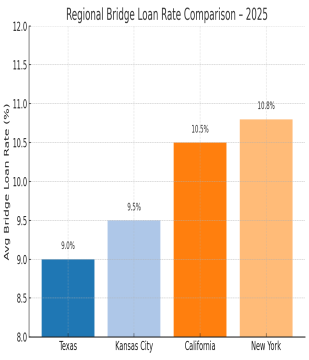
Bridge loans are for properties that are not ready for agency or bank debt yet. Think of a value-add deal with a pile of vacant units or a building in the middle of renovation. They close faster and cost more. The whole plan is to stabilize the asset and refinance into permanent debt, so you need to know how that refinance will be sized before you take the bridge. Our bridge financing page walks through that exit math.
Ways to close the gap
Going back to the $1.2 million hole, you have a few honest options. The most obvious one is more equity. It is also the one nobody wants to hear. The second is a price reset. If the lender's number is the real number, the seller's price may need to move, and you are in a much better position to ask if you find out early.
The third is structure. Some programs offer an interest-only period at the front of the loan. In our example, interest alone on $9 million at 6.25% is $562,500 a year, and $720,000 divided by that is a coverage ratio of about 1.28. Suddenly the 75% request clears the test. Interest-only periods are not available on every deal and they shift risk to the back end of the loan, so they are a tool to price carefully and not a trick.
What lenders check on a Plano deal
Three items move the number more than most borrowers expect. The first is trailing twelve month income, meaning what the property collected, not what the pro forma says it will collect. Lenders trust bank deposits over projections every time.
The second is property tax. Lenders commonly underwrite taxes on the purchase price instead of the seller's current bill, and on a recent sale that can take a real bite out of net operating income. A property that looks like a $720,000 asset on the seller's tax bill can be a $680,000 asset after reassessment, and that changes the loan.
The third is insurance, a line item lenders now study closely. Reserves and your own liquidity round out the file. A strong sponsor with cash in the bank gets better terms than a stronger property with a thin borrower behind it.
Before you go hard on earnest money
Get the sizing done while you still have a free exit. Send a rent roll and a trailing twelve to someone who can run the coverage test against each loan type, and ask for real proceeds, not a best-case range. If the number comes back short, you have time to renegotiate or walk. If you wait until after the deposit is hard, you are negotiating with a clock running.
How we handle it
We are a broker, not a lender. We take your rent roll and T-12, run the sizing test against each loan type before anything goes out, and shop the deal across our lender network so you see real proceeds before you commit to a purchase price. If the coverage math shows a gap, we tell you early, while you can still do something about it.
Start with our multifamily loan page, run your own numbers on the refinance calculator, or request an advisory consultation.
Partner With Terrydale Capital for Your Debt Financing Needs
When it comes to debt financing, understanding the right timing, process, and options is crucial. At Terrydale Capital, we provide a comprehensive range of commercial loan solutions tailored to meet your business's unique needs.












































































Success!
Product has been created successfully!
Headquartered in Dallas, Texas, Terrydale Capital is a leader in commercial real estate financing. We have close relationships with the nation’s top banks, lenders & family offices allowing us to provide the most competitive financing solutions in the market.


